Do not hesitage to give us a call. We are an expert team and we are happy to talk to you.
+84-963.410.068
info@indochinakitetravel.com
Itinerary in details:
Day 1: Arrive – Siem Reap, Sour Sdey “Hello” Cambodia (-/-/-)
Upon arrival at Siem Reap Int’s Airport, process immigration procedure (visa on arrival is available or obtain in advance via www.evisa.gov.kh), then get your luggage and walk straight to the Exit Gate where our representative is waiting. After self-introduced, you’ll transfer to hotel in the city (check in time is 2pm). Time to fresh-up and relax at hotel.
Overnight in Siem Reap.
Day 2: Rolous Group & Grand Circuit (B/-/D)
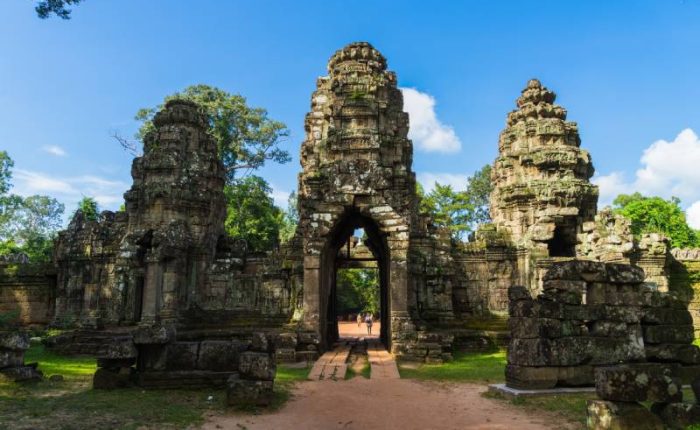
After breakfast, we depart to Preah Khan Temple. It is located northeast of Angkor Thom and just west of the Jayatataka baray, with which it was associated. It was the center of a substantial organization, with almost 100,000 officials and servants. Next is Neak Poan, “the entwined snakes” is a small temple located on an island in the center of the now dry Jayatataka baray, a water reservoir 3,500-meter-long and 900 meter wide. Continue to Tasom offers some beautiful photo spots, especially the rear entrance where tree roots adorn the gateway.
Visit the Rolous Group including Lolei, Preah Ko & Bakong temple first. This island temple consists of four brick towers on a double plate rite platform. The 3 temples Bakong, Lolei and Preah Ko – located southeast of the Siem Reap Market – comprise the Rolous group of monuments and are dating back to the late ninth century and is the earliest site of the 600 years Angkor Period that is open to visitors.
Dinner with Apsara Dance show at local restaurant.
For those travelers thirsting for cultural highlights of Cambodia, no visit to Cambodia is complete without attending at least one traditional Khmer dance performance, often referred to as ‘Apsara Dance’ after one of the most popular Classical dance pieces. Traditional Khmer dance better described as ‘dance-drama’ in that the dances are not merely dance but also meant to convey a story or message. Overnight in Siem Reap.
Day 3: Angkor Highlight (B/L/-)
We start very early in the morning so we can capture the iconic picture of the pre-dawn facing Angkor Wat temple. Sunrise at Angkor Wat can be a busy venue especially during the months of December, January, February, and March.
After sunrise, we will explore the vast and rich of Angkor Wat temple, taking pictures at different angles, playing with light and shadows, and capturing the most beautiful devatas carved in sandstone.
Next destination will be the Ta Prohm “Tomb Raider” fame. Ta Prohm has been abandoned to the elements, a reminder that while empires rise and fall, the riotous power of nature marches on, oblivious to the dramas of human history. Left as it was ‘discovered’ by French explorer Henri Mouhout in 1860, the tentacle-like tree roots here are slowly strangling the surviving stones, man first conquering nature to create, nature later conquering man to destroy.
Next, will be the impressive Bayon temple with its 54 towers and 216 faces overlooking the defunct city of Angkor Thom. The final stop will be at one of gate of Angkor Thom to capture sunset over the moat. Overnight in Siem Reap.
Day 4: Rolous Group & Grand Circuit (B/L/D)
We’ll escape the heat of the city by driving 48kms North of Siem Reap to visit the holy Kulen Mountains, also referred to as Phnom Kulen (Mountain of the Lychees) by locals. The sandstone from this mountain was the main supplier of construction materials for the Angkor Kingdom. We’ll stop at the sacred site of The River of a Thousand Lingas, which features hundreds of lingas carved in the sandstone bed of the river, which date back to the 9th century.
Further downstream, large blocks of stone, also under water, are carved with Apsaras dancers and Vishnu figures. Next on the agenda is a wander around the mountain-top pagoda which is home to relics, statues and a large reclining Buddha. The last mountain stop will be Kulen Waterfall, featuring a natural pool which is the perfect place to cool off on a hot day and a great picnic spot too, so that’s what we’ll do. We return to Siem Reap and visit the smallest, but magnificent, Banteay Srei built in the 10th Century and dedicated to Shiva. The temple was the birthplace of Khmer classical style architecture, and the bas-relief work is the best example of Khmer classical art remaining.
The pink sandstone structure bears a series of striking and beautiful sculptures, lintels, pediments, and friezes. Khmers say the temple must have been carved by women for the details are too fine for the hands of a man. On the way back stop at Pradark Village, where you will see the villagers making palm sugar, handicraft for selling to tourist. It’s a nice chance for you to see the local people living at the countryside with their struggling for daily life.
Overnight in Siem Reap.
Day 5: Siem Reap – Departure (B)
After meeting, we depart to Tonle Sap Lake. We will visit the floating village of Kampong Phluk, which means “Port of Tusks”, located 20 km east of Siem Reap. It is a village built on stilts on the Tonlé Sap. The community largely depends on fishing for a living, spending Cambodia’s rainy season (June-October) fishing. During the dry season (November-April), when the waters of the lake go down, many of them work in agriculture to supplement their income.
The excursion will take you to explore the floating village and allow you to see how people live and trade. We go to local pagoda, where you should change to clothes, we can get wet in as here we will experience the ceremony “Srouch Teok”, which roughly translates into “Water blessing”. A monk will chant in ancient Pali as he splashes water over us, washing away our sins and bad luck so we can start fresh and by being a good person can increase our good luck.
Return in town, we will go to visit Satcha Artisans and wood carving, lacquer ware, polychrome products, silver plating and silk paintings. In there, we can take a tour through the workshops and watch students as they learn how to create silk fabrics and garments, stone.
Transfer to Siem Reap airport for departure to next destination. It’s time to say goodbye, we thank you for traveling with us and warmly welcome you to come again.
INCLUDES:
NOT INCLUDES:
– Vietnam visa is compulsory for nationalities except for ASEAN countries, Japan, Korea. And citizens of Norway, Denmark, Sweden, Finland visiting Vietnam for up to 15 days are exempted from visas. Vietnam visa which is valid in 30 days, is issued by Vietnamese embassies or General Consulate abroad, or upon arrival to Vietnam international airports. It is not difficult to arrange visa on arrival to Vietnam. The entry visa will be stamped on your passport when you pass through our immigration checkpoint at the airport. In order to apply for Vietnam visa on arrival, please visit www.vietnamvisaprovider.com.
– Yes, you can. Cash advances on credit cards are available at the central Techcombank, Vietcombank in Hanoi, Ho Chi Minh city and other major ones, you will be charged about 4% for that.
– Booking a tour with Indochina Kite Travel is very easy for your payment which can be made by cash, paypal, wise transfer, telegraphic transfer or credit cards. Except for cash payment, a service charge will be applied. Any bank charges are levied by the sending bank relating to transfers to Indochina Kite Travel must be paid by clients. A surcharge of 3% will be applied for payment by credit cards.
– Vietnam climate is particularly complicated like some different countries in the world. Weather patterns have been changing over recent years. The climate of Vietnam is described in details as below:
Northern Vietnam climate:
– The Winter (December to March) can be surprisingly bitter for cold air sweeps from the south of China, persistent mist and temperatures as low as 7°C. Things start warming up again in April, which ushers in a good period, spring weather before summer heat begins in earnest in May, closely followed by the rainy season in June, July and August. This combination makes for hot, sticky weather which makes many people surprised. The temperatures can occasionally reach 42°C, average 30°C, while humidity hovers about 75-80%. The rain comes in heavy downpours, causing frequent flood in Hanoi and the delta. By September, the rains are petering out. The Autumn (September to December) is undoubtedly the most pleasant season. At this time of year, it’s generally cool, the average temperature is about 20°C to 22°C. From September to middle October, it’s perfect sightseeing weather.
Central coast Vietnam climate:
– The coastal region from Thanh Hoa province to Hue lies in the typhoon belt. Around Hue, typhoons are the most prevalent from April to June, while further north, the season generally lasts from July to November. However, typhoons are quite difficult to predict and it really is a matter of bad luck or luck, if you are caught. Flights are usually only disrupted for a matter of hours, but for recent years the main road and rail routes heading the south have been cut by floods at least once during the typhoon season. The good news is that they are recovered incredibly quickly within 2 to 3 days, depending on the level of severe damage.
The climate in the central region of Vietnam is notoriously wet, particularly around Hue, where the annual average rainfall is a generous 4m. The so-called ‘dry’ season lasts from February to May. After this, it gets hotter around 30°C to 32°C until the rainy season start in earnest in September, gradually easing off from November through January. The average temperatures in the Winter are pleasant from 18°C to 22°C.
Central highlands of Vietnam climate:
The rainy season in the central highlands commence from May to November. Roads are regularly washed out, but it is also quite nice at this time with tumbling rivers, beautiful waterfalls.
Southern Vietnam climate:
The southern Vietnam follows roughly the same weather pattern as the central highlands. It is blessed with a fair and predictable climate. The dry season lasts from December to May. The rainy season is the rest of a year. Most of the rains fall in brief afternoon downpours, so you can still enjoy outdoor activities, although flooding can be a problem in the southern delta. Daytime temperatures rarely fall below 22°C, occasionally reach 35°C in the hottest months (April to May). Humidity climbs to enervating 75%.
No need to take vaccination before entering Vietnam. However, for safety reason and for your health guarantee you should be consulted by your doctor before you travel. Some travelers may take malaria vaccination. You should also bring insect repellent to avoid bitten by mosquitoes, bugs in some places.
Our recommended tour is customized tour for Indochina Kite Travel will create the tour to meet your personal demands, interests and budget. What you need is sending us your travel inquiry at https://www.indochinakitetravel.com and your private travel consultant at Indochina Kite Travel will work out a perfect tour itinerary for you.
Travelling in Vietnam, you can easily look for a bank to exchange money. However, the rates may be slightly different. We advise you to check the rates here: http://vietcombank.com.vn
Yes, you can. But you must have a proper driving license. However, driving a car in Vietnam is very difficult due to bad traffic. We advise you rent a car and a driver if you expect to go somewhere.
Yes, you can. But there are some restricted areas close by the border like Meo Vac, Dong Van in Ha Giang province, Ban Gioc waterfall… You have to apply for permission before visiting that. It is the best way to book a tour package at https://www.indochinakitetravel.com
The Vietnamese welcome people from all countries and races. The war is the past and it’s not your mistake. What the Vietnamese care is how to live in peace in order to have a better life at present and in the future.
Vietnamese law is very strict. All types of drugs are strictly forbidden. Don’t risk to sell or use that under any circumstances.
Yes, a lot. Vietnam has witnessed a surge in internet use for recent years. Now it has more users than other countries in Southest Asia. Internet facilities are available at all hotels, restaurants… during your Vietnam vacation.
Yes, you can. But they must be good quality ones because exporting a artifact with cultural significance needs an official license. Without a license, anything old is confiscated at the airport
Yes, bargaining need to be done at local markets, open shops but not at supermarkets, shopping centers, minimarts. Bargaining depends on what products you are going to buy, so the best ways is asking your tour guide to be more convenient.
No problems, but share with us that before you start the tours. It is possible for us to order vegetarian or vegan meals for you. Vietnam is very well-known for good food, it is easy to serve you that at your taste.
Social Chat is free, download and try it now here!